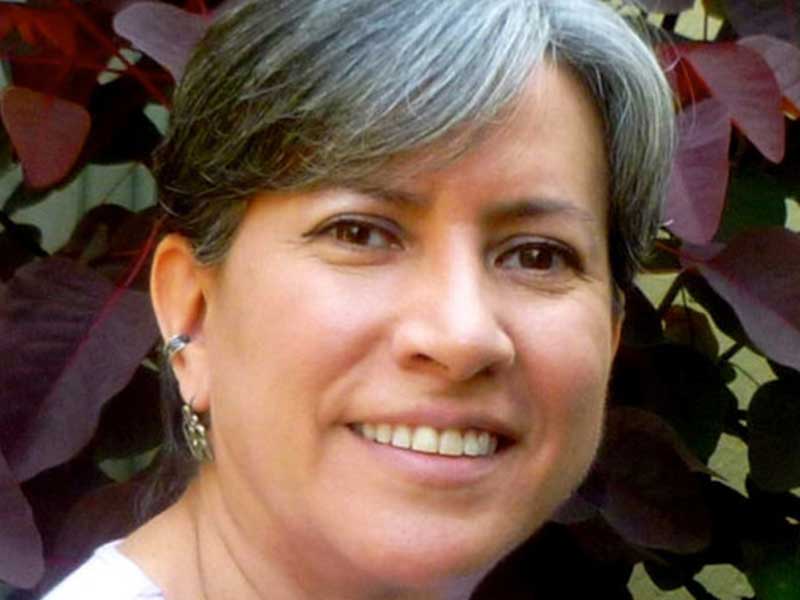
In 2009 María Luisa Zorrilla, faculty and researcher at the Universidad Autónoma del Estado de Morelos (Autonomous University of the State of Morelos, Mexico) was given the responsibility of creating the Direction of Multimodal Education (short-named e-UAEM), the institutional department intended to introduce and promote the use of ICT in educational programs.
e-UAEM mainly produces virtual and hybrid courses for multimodal degree programs offered by the University. Given UAEM is a public institution, since e-UAEM’s creation Maria Luisa Zorrilla established an openness policy based on the use of Creative Commons Licenses for all produced educational resources.
In 2016 the nominee identified the lack of online educational resources on digital competencies, and proposed a Digital Culture Program for UAEM, as a strategy created to build digital literacy within the university community, but also for the society at large.
The different courses focused on digital culture, both curricular and extracurricular created within this program, have been championed by one person, María Luisa Zorrilla, who has acted as content expert in most of them (including annual updating), instructional designer, tutor and who has also negotiated with external agencies, such as MexicoX and UNESCO to amplify the program’s reach beyond the institutional boundaries. She has also introduced design innovations, derived from her research, such as the use of narratives and gamification in MOOC design.
UAEM’s MOOC “Alfabetismo Mediático e Informacional” is included in the UNESCO MIL website. Another UAEM’s MOOC, “Exploradores de la Posverdad vs. Noticias Falsas” received the GAPMIL Award in 2018, sponsored by UNESCO. Additionally, the UAEM Digital Culture Program received the ANUIES TIC Recognition in 2019 in the category of “Transformation of Educational Practices through ICT”.
Furthermore, applied research has been conducted on the operation of these courses, and results have been published in academic journals and books. The most recent and notable of these is a chapter dedicated to the MOOC “Explorers of Post-truth” in the book “Democracy 2.0. Changing Frames of Media Literacy” (2021).
In 2023, the nominee coordinated an interinstitutional publication: the Guide of Quality Indicators for Digital Educational Resources, available in open access.
More information about Dra. Zorrilla’s publications.
Even though the OE project referred in this nomination is institutional, there is one individual that has been the motor propelling it for years, and that is why this nomination is personal.
Award Nominator
The nominee of María Luisa Zorrilla highlights the influence of MOOCs as part of open education. Having the 6 MOOCs in Spanish has a reach within Mexico and into Central and South America… As an educator her influence has been quite substantial through the reach of the MOOCs.
Award Reviewer
Explore more about this awardee…
Receiving the OER Award last year was a great source of motivation, not only for me personally, but also for the e-UAEM team at the Autonomous University of the State of Morelos in Mexico, where we have been working for the past ten years to produce innovative and disruptive MOOCs on Digital Culture topics.
We strongly believe that open educational resources should embody the highest standards of content quality while also reflecting pedagogical innovation, by introducing disruptive strategies such as storytelling and gamification.
This award has brought greater national and international visibility to our work, encouraging us to continue contributing to the OER ecosystem.
Testimonial from Maria Luisa Zorrilla
- MOOCs in Mexico (en español)- a video produced for the 10th anniversary of MexicoX—the platform where the UAEM MOOCs are published. Lic Bruno Salvador Hernández Levi emphasizes the international reach of MexicoX achieved, including the OE Award for Excellence.
Podcasts from Open Education Global
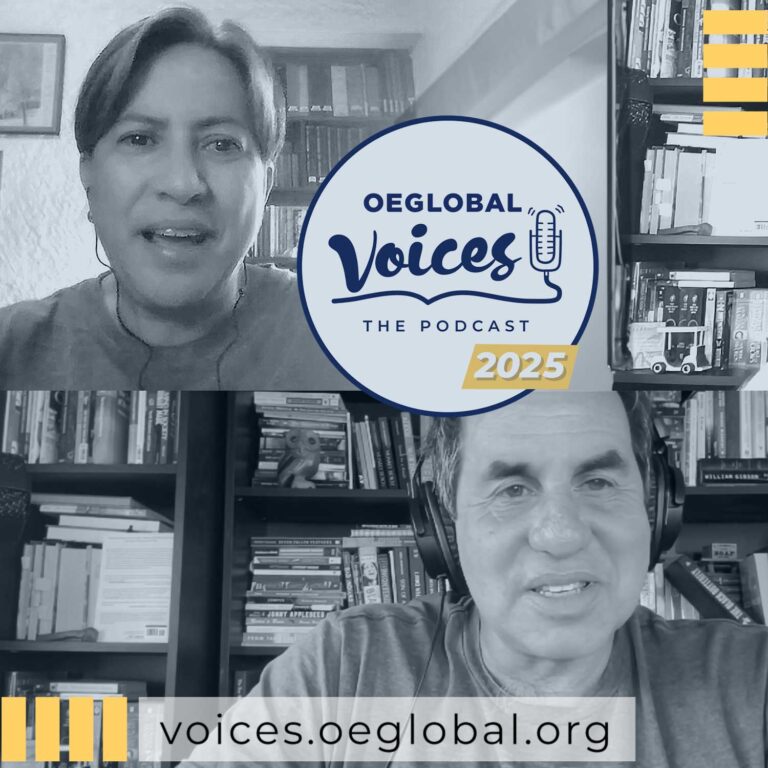
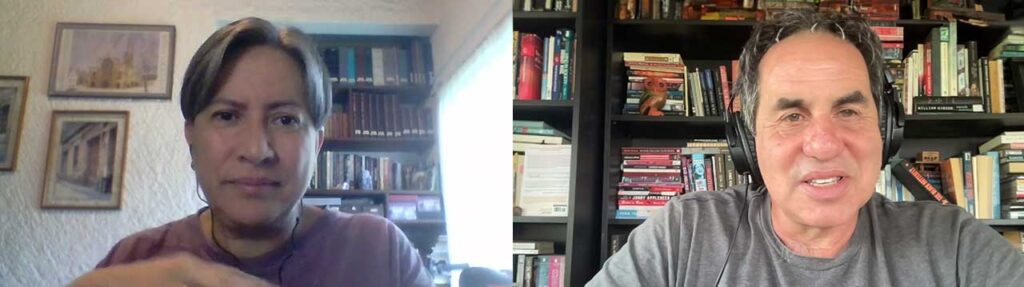
In another in our series of conversations with winners of Open Education Awards for Excellence, we take you to the city of Cuernavaca in central Mexico to hear the voice of Maria Luisa Zorrilla, an open educator at Universidad Autónoma del Estado de Morelos (UAEM). In 2024, Maria Luisa was recognized with an OEAward Individual Award as an Educator.
Maria shares her path into open education via studies in Communication, through being early on the web supporting the national fishing industry, her masters study of educational television, PhD research in the media convergence of television and the internet from the University of East Anglia, in the UK, all leading to her role now at UAEM as Director of Multimodal Education. It is here she has been part of this public university’s commitment to educating all citizens in the State of Morelos through online learning and 10+ years of MOOCs plus research and teaching in digital culture.
Listen in for a conversation where almost every line could be a highlight quote.
at Descript.com
In This Episode
FYI: For the sake of experimentation and the spirit of transparency, this set of show notes alone was generated by the AI “Underlord” in the Descript editor we use to produce OEGlobal Voices.
Exploring Open Education and Digital Culture with Maria Luisa Zorrilla
In this episode of OEGlobal Voices, recorded on July 25, 2025, host Alan Levine engages in a conversation with Maria Luisa Zorrilla, a celebrated researcher and educator from the Autonomous University of the State of Morelos in Mexico. Maria Luisa, who was awarded an Open Education Award for Excellence, shares her journey and insights on digital culture, MOOCs, and the future impact of artificial intelligence in education. She discusses her career evolution, the importance of digital literacy, the significance of MOOCs in Mexico, and her thoughts on transmedia narratives. The episode emphasizes the commitment to open educational resources and the continuous evolution of educational practices.
- 00:00 Intro Music and Highlight Quote
- 00:38 Podcast Episode Introduction
- 02:02 Conversation with María Luisa Zorrilla
- 03:58 María Luisa’s Background and Career Path
- 07:58 Open Education and MOOCs at UAEM
- 15:44 Digital Culture and Technology in Education
- 22:19 Artificial Intelligence in Education
- 27:27 María Luisa’s Teaching and Research Interests
- 32:45 Closing Remarks and Reflections
(end of AI generated show notes)
Additional Links and Quotes for Episode 89
[In 2010 the Autonomous University of the State of Morelos.] wanted to start a distance education project. So I launched the UAEM project at that time. This is a public university. From the very beginning I was convinced that all the educational resources we created for distance and for hybrid learning should be open. So we adopted Creative Commons licenses for everything we produced.
Now we are celebrating 15 years of doing just that. As for the MOOCs, when they started becoming a trend around, I remember about, 2012 or 2013, more or less. We were curious. Since I lead the area in charge of creating online learning content, it felt natural for us to experiment. That’s how we launched our very first MOOC in 2016, Internet Searching for Higher Education Students. Now it’s been running for 10 years.
Maria Luisa Zorrilla on open education at UAEM
- Maria Luisa Zorrilla OEAwards for Excellence, 2024 Educator Award
- EDUCATIONAL TELEVISION BEYOND THE TV SET Educational Media Convergence in the UK and a Proposal for the Mexican Model (PhD Thesis)
- BBC Schools (Wikipedia)
- Zorrilla, María Luisa. (2005). Comunidades Virtuales en Internet. Definición y clasificación. Acta Sociologica. 77-91.
- EDUCATIONAL TELEVISION BEYOND THE TV SET Educational Media Convergence in the UK and a Proposal for the Mexican Model (PhD Thesis)
- Cuernavaca, capital of Morelos, Mexico (Wikipedia)
- Popocatépetl volcano (Wikipedia)
- Code and Other Laws of Cyberspace by Lawrence Lessig (Wikipedia)
- Mexico etc versus US: ‘tuna-dolphin’ (World Trade Organization)
- Universidad Autónoma del Estado de Morelos (Autonomous University of the State of Morelos)
- Educación Multimodal, pilar para el futuro educativo en la UAEM
- MOOC: Búsqueda en Internet para Universitarios (MOOC: Internet Search for University Students)
- Education in Mexico (Wikipedia)
- Preparatoria Wikipedia)
- Telesecundaria (Wikipedia)
- Secretaría de Educación Pública (Gobierno de México/Ministry of Public Education, Government of Mexico)
- Plan México Gobierno de México
- MéxicoX MOOC platform (@prende.mx)
- 4 ways micro-credentials and skills-based hiring can help displaced workers access jobs of the future (World Economic Forum)
When I did my masters degree I studied virtual communities. At the time it was very new. There was an author, Howard Rheingold, who wrote a book about virtual communities. He was my guru! There’s where I started being interested in technologies and digital culture. Thinking of it of different ways, [digital culture] is just how people are in the net, how they exist in the net, but also how they act, how they do things, but also with which capabilities, with which competencies.
Maria Luisa Zorrilla on digital culture
- Howard Rheingold (personal web site)
- The Virtual Community book (Wikipedia)
- read online (hrheingold.com)
- The Virtual Community book (Wikipedia)
- Transmedia Storytelling (Wikipedia)
That’s why in our university we are working in some guidelines for all the communities, students, teachers, everyone, to establish certain rules for everyone. What is allowed? What is not allowed? And how do you make visible you are using these tools, how are you using them and what percentage of the work you are presenting is done by this technology.
A very important thing is making student conscious of what they might lose in their education, in their own building as persons if they use that a lot. For example, when I write in English, sometimes I have doubts how to say something, but I make myself write in English first with my brain. And then I ask for example, ChatGPT, please proofread this. And so I check what was changed and what was corrected. But then I still I keep my writing because if I write it in Spanish and say “Please translate to English”, that’s easier. I don’t have to think in English. But then I will lose my capability of writing in English, I don’t want to lose that.
That’s what I’m trying to tell the students that, please don’t go to de-skilling. No, please upskill or re-skill, but that de-skill, no.
Maria Luisa Zorrilla on Artificial Intelligence
Listen to more from our episodes recorded with Open Education Awards for Excellence winners.
Our open licensed music for this episode is a track called The Threat of Education by Independent Music Licensing Collective (IMLC) that is licensed under a Creative Commons Attribution-NonCommercial-NoDerivatives license. Like most of our podcast music, it was found at the Free Music Archive (see our full FMA playlist).