The Open for Antiracism (OFAR) program provides faculty from across the California Community Colleges with training on how to leverage OER and Open Pedagogy in order to make their teaching antiracist.
OFAR emerged as a response to the growing awareness of structural racism in higher education in the United States. In the summer of 2020, many institutions published statements decrying racism, calling for change, and putting equity into their strategic plans, but few if any expressed plans for changing teaching practices that directly affect students. OFAR started with the premise that faculty wanted to change their teaching to be antiracist and that OER and open pedagogy were tools that would facilitate that work.
The California Community Colleges, the largest system of higher education in the U.S. serving 2 million students at 116 colleges, provides a diverse and large sample within which to test this premise. Through OFAR’s first 4 years, it has supported 150 faculty at 40 colleges in making their teaching antiracist.
Colleges have attempted to integrate antiracist pedagogies into their classroom, however there hasn’t been one that looked at the problem through an open education lens and provided a supportive safe environment where faculty could learn about antiracist teaching and apply it in their own classroom. OFAR provides training on how OER and Open Pedagogies can be leveraged for antiracism in addition to hosting monthly webinars on a variety of topics, such as “Practical Steps for Implementing Antiracist Pedagogy with OER” with Amanda Taintor and Suzanne Wakim, and “Black Feminist Pedagogy and Open Education,” with Jasmine Roberts-Crews.
A key element of success arises from bridging the gap between Open Education and other realms of knowledge and activism.
OFAR also engages in rigorous research to explore the impact of antiracism on student learning and faculty teaching. Our year three research illustrates the impact OFAR has had on student learning and experience and stands as a model for how to implement actionable DEI measures in higher education. A highlight of findings from year three shows that faculty participants’ confidence increased significantly.
Multiple institutions across the US have adapted and used OFAR’s course in their own context: Evergreen Valley College in California, Cosumnes River College in California, the Wisconsin Technical Colleges, Lehman College in the Bronx (part of the City University of New York), and Northern Virginia Community College. We hope that these innovations and adaptations of OFAR are a positive sign of how Open Education can support antiracist work to evolve in different educational settings.
Within the context of US community colleges, OFAR is the only formal professional development program to explicitly show how Openness can support antiracism.
Award Nominator
What a fantastic project and huge resource to not only faculty and students in California, but anyone interested in anti-racism education.
Award Reviewer

Explore more about this awardee…

Podcasts from Open Education Global
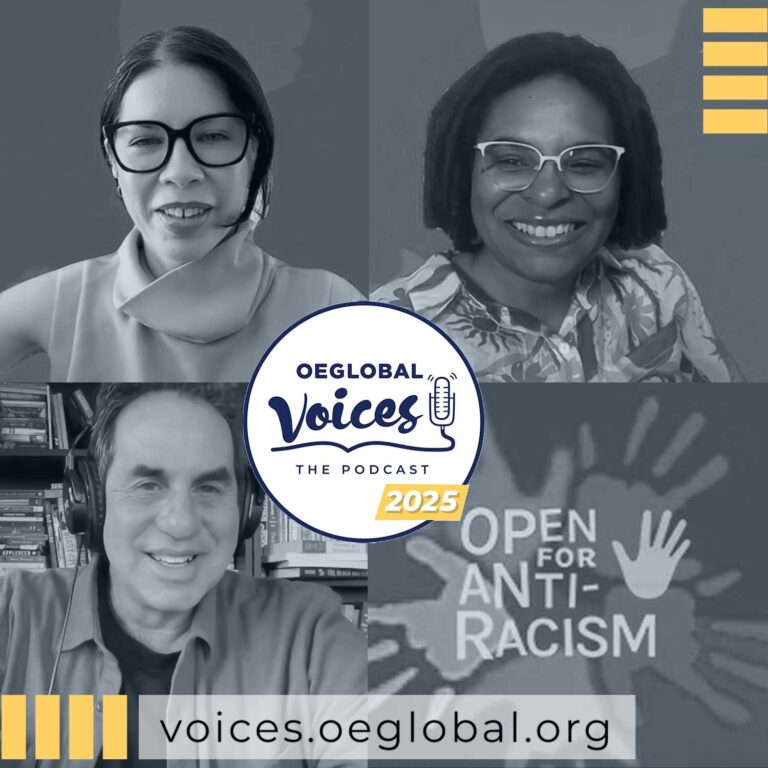
As a perfect last episode of the 2025 OEGlobal Voices podcast, we are delighted to share an inside look at the workings and impact of the Open For Anti-Racism program (OFAR) You will hear in the voices of Laura Dunn and Jamie Thomas how this has succeeded as a collaborative effort to increase the integrations of open educational practices and pedagogy for faculty to make their classes ever more accessible and responsive to the learning needs of students in community colleges across the state of California.
OFAR, a project led by CCCOER (and OEGlobal), not only includes professional development through course materials facilitated by expert coaches, but also a process where each participant develops an Action Plan that is carried out in courses they teach the following semester. OFAR truly is the kind of professional development that goes far beyond resources and training, but supporting changes in pedagogical strategy. And this is accomplished through a distributed cohort model.
Listen closely in the conversation how Laura and Jamie both refer to “students”, not only the learners ultimately in community colleges courses, but often they refer to the “students” as the faculty participants themselves. You will understand why there has been interest in this program from other educators in the US plus Canada as well. And you will hear of the future plans to publish and share an OFAR “Toolkit”.

at Descript.com
In This Episode
FYI: For the sake of experimentation and the spirit of transparency, this set of show notes alone was generated by the AI “Underlord” in the Descript editor we use to produce OEGlobal Voices.
OFAR and Open Pedagogy: Bridging Equity and Education
Join host Alan Levine in an enlightening conversation with Laura Dunn and Jamie Thomas, key figures in the Open for Anti-Racism (OFAR) program. This episode delves into how OFAR empowers community college faculty to incorporate open educational resources (OER) and open pedagogy in their teaching. With personal anecdotes and professional insights, the guests discuss the transformative impact of culturally responsive strategies and community collaborations. Highlights include real-world examples of innovative course projects and the challenges and successes of implementing anti-racist teaching practices. This episode emphasizes the interconnectedness of educational communities and the ongoing efforts to make learning inclusive and accessible for all.
- 00:00 Intro Music and Selected Quotes
- 01:46 Welcome to OEGlobal Voices Podcast
- 02:07 Meet the Guests
- 02:36 Understanding the Open for Anti-Racism (OFAR) Program
- 06:50 Personal Backgrounds of Laura and Jamie
- 11:47 The Genesis of OFAR
- 16:16 Implementing OFAR in Community Colleges
- 22:18 Challenges and Successes of OFAR
- 25:19 Community and Collaboration in OFAR
- 54:40 Future Directions and Toolkit Development
- 58:49 Closing Remarks and Personal Insights
(end of AI generated show notes)
Additional Links and Quotes for Episode 94
So OFAR steps in then as a really actionable professional development program that helps faculty harness the power of OER and open pedagogy in their classrooms and in their teaching so that their teaching can become more accessible, regardless of student backgrounds. Students are then invited to bring their quote unquote whole selves. We say that a lot, in colleges and universities, but do we really mean it?
But within OFAR we’re really looking for ways and strategies to help faculty bring their students– the whole student– into the classroom. Community colleges across the state of California and OFAR has had cohorts and teams from these colleges over the past six years now who are learning how to apply OER and open pedagogy to their teaching.
Laura Dunn
- Open for Anti-Racism program (OFAR)
- OFAR Course (Self-paced open course and Facilitated Courses available through Canvas Commons)
- OFAR webinars
- OFAR Impact and Research
- Classroom Action (quotes and videos)
- Resources created by OFAR 2020-2021 Cohorts
- Resources by OFAR 2022-23 Cohorts (OER Commons)
- Alphabetic Listing of Californis Community Colleges
- California Central Valley (Wikipedia)
- Laney College
- Real College CA Student Survey
- Jasmine Roberts-Crews
- Adapting for Anti-Racism: Collaboratively diversifying faculty open professional development by Stacy Katz and Sherry L. Deckman, CUNY Lehman College
- Guide to OER and Antiracism (Wisconsin Technical College System remixed from OFAR course)
One of the things we talk about with folks as we also have them connect with past participants through say a live webinar so that they can learn from other folks who’ve gone through this journey… we can try to help them be as adaptable as possible to whatever course they might end up getting assigned to at the last minute. Or, the particulars of who their students are and what their students are interested most in learning. And sometimes that connects really well with this idea of wanting to localize, say, a Biology curriculum or a History curriculum or a Cosmetology curriculum so that what is learned in the class also has immediate relevance to the neighborhood environment where our students are circulating and possibly going to serve new clients or stand up programs of their own.
Jamie Thomas
Our open licensed music for this episode is a track called Everyone Knows Itby Xennial that is shared under a Attribution-NonCommercial-ShareAlike 4.0 International License. license.Like most of our podcast music, it was found at the Free Music Archive (see our full FMA playlist).